+86-18368206374
 No.99,Yuma Road,Mazhu Town,Yuyao City,Zhejiang Province,China.
 English
 русский
 Español
 عربى
عربى 中文简体
中文简体
No todos los filtros de agua son iguales. Esta guía elimina la confusión con una comparación directa respaldada por datos de cada tipo de filtración importante para que pueda encontrar el sistema adecuado para su hogar, su presupuesto y sus necesidades de calidad del agua.
¿Qué tipo de filtro de agua es el adecuado para usted? La respuesta corta
Para la mayoría de los hogares, un sistema de ósmosis inversa debajo del fregadero ofrece la mejor filtración integral. Los filtros de jarra ganan con el costo inicial. Los filtros para grifos ofrecen la mejor relación comodidad-costo. Los sistemas para toda la casa son la única opción que protege todos los grifos, duchas y electrodomésticos del hogar.
comprensión ¿Qué hacen los filtros de agua? a un nivel básico es el punto de partida para cada decisión de compra. Todos los filtros de agua funcionan haciendo pasar el agua a través de uno o más medios de filtración que atrapan, absorben o neutralizan los contaminantes antes de que el agua llegue al vaso. Las diferencias clave entre los tipos de filtros son los medios utilizados, los contaminantes eliminados, el caudal entregado y el costo de propiedad a lo largo del tiempo.
Esta guía para compradores de tratamiento de agua cubre todas las categorías principales de filtros de agua de punto de uso y sistemas para toda la casa, explica qué elimina realmente cada tipo y le brinda un marco de comparación directo para tomar la decisión correcta la primera vez.
¿Qué hacen realmente los filtros de agua? Comprender los conceptos básicos
Antes de comparar sistemas, es útil comprender ¿Qué hacen los filtros de agua? a nivel mecánico. La mayoría de las opciones de filtración de agua residencial funcionan a través de uno o más de estos mecanismos principales:
- Filtración mecánica: Una barrera física con un tamaño de poro nominal (medido en micrones) que bloquea partículas, sedimentos, quistes y algunas bacterias. Un filtro de 0,5 micras bloquea mucho más que un filtro de 5 micras.
- Adsorción (carbón activado): Los contaminantes se unen químicamente a la superficie de un medio de carbono poroso. Este es el mecanismo más común en los filtros de jarras y grifos y es particularmente efectivo contra el cloro, las cloraminas, los COV y muchos compuestos de sabor y olor.
- Ósmosis inversa (RO): El agua pasa a través de una membrana semipermeable con poros tan pequeños como 0,0001 micrones, eliminando sólidos disueltos, metales pesados, nitratos, fluoruros y la mayoría de los demás contaminantes. La RO es ampliamente considerada la tecnología de filtración residencial más completa.
- Intercambio iónico: Los minerales del agua dura (calcio y magnesio) se intercambian por iones de sodio o potasio, ablandando el agua. Común en ablandadores de agua y algunos sistemas de filtrado combinados.
- Tratamiento UV: La luz ultravioleta desinfecta el agua inactivando bacterias, virus y otros microorganismos. Los rayos UV no eliminan los contaminantes químicos, pero son muy eficaces como etapa final de desinfección.
Lo mas moderno filtro de agua de buena calidad Los sistemas combinan dos o más de estos mecanismos en secuencia para abordar múltiples categorías de contaminantes simultáneamente. La calidad de los medios de filtración y el tiempo de contacto entre el agua y los medios son los dos factores más importantes que separan los sistemas de alto rendimiento de las opciones económicas.
Filtros de agua de jarra: asequibles, simples y mejores para hogares pequeños
Los filtros de jarra son el punto de entrada para que la mayoría de las personas aprendan Cómo filtrar el agua del grifo en casa. . El agua se vierte en el depósito superior, pasa lentamente a través de un cartucho de filtro cerámico o de carbón activado por gravedad y se acumula en la sección inferior de la jarra, lista para beber.
Qué eliminan los filtros de jarra
La mayoría de los filtros de jarra estándar que utilizan tecnología de bloque de carbón activado están certificados para reducir el sabor y el olor del cloro, algunos metales pesados (plomo, cobre) y ciertos COV. Los filtros de jarra de primera calidad, como los que utilizan un bloque de carbón de múltiples etapas y medios de intercambio iónico, pueden reducir aún más el mercurio, el cadmio y algunos productos farmacéuticos. Sin embargo, los filtros de jarra estándar no eliminan los nitratos, el fluoruro, las sales disueltas ni la mayoría de las bacterias y virus. sin medios especializados.
Limitaciones de caudal y capacidad
Los caudales del filtro de jarra son realmente lentos por diseño, ya que el tiempo de contacto adecuado con el medio de carbón es esencial para una filtración efectiva. Una jarra estándar de 10 tazas normalmente requiere De 5 a 15 minutos para filtrar un lote completo , lo cual es una compensación aceptable para una o dos personas pero resulta frustrante para hogares más grandes. La mayoría de los cartuchos de jarra tienen una capacidad nominal de 40 a 150 galones antes de que sea necesario reemplazarlos, lo que se traduce en aproximadamente de 1 a 3 meses de uso típico.
Análisis de costos: filtros de jarra a lo largo del tiempo
El costo inicial es la principal ventaja. Un sistema de filtro de jarra de buena calidad normalmente cuesta $25 a $60 para la unidad inicial, los cartuchos de repuesto cuestan entre 8 y 20 dólares cada uno. Para un hogar que utiliza un cartucho por mes, los costos anuales continuos oscilan entre $96 y $240. Esto es significativamente más alto por galón que los sistemas debajo del fregadero o para toda la casa a escala, pero el bajo costo de entrada hace que las jarras sean la opción más accesible para inquilinos o compradores preocupados por su presupuesto.
Filtros de agua montados en grifos: el punto óptimo de comodidad
Los filtros montados en grifos se conectan directamente al extremo de un grifo de cocina estándar y representan uno de los más populares. filtros de agua de punto de uso para inquilinos y apartamentos. Proporcionan agua filtrada según demanda con solo girar un interruptor, evitando el tiempo de espera inherente a los sistemas de jarra.
Cómo funcionan los filtros de grifo
La mayoría de los filtros de grifo utilizan un cartucho de bloque de carbón activado comprimido alojado en una unidad pequeña que se enrosca o se engancha al aireador del grifo. Una válvula desviadora le permite cambiar entre agua filtrada (para beber y cocinar) y agua sin filtrar (para lavar platos), lo que prolonga la vida útil del cartucho. El caudal a través del modo filtrado suele ser 0,5 a 1,5 galones por minuto , notablemente más lento que el flujo sin filtrar pero lo suficientemente rápido para un uso práctico.
Limitaciones de compatibilidad
La limitación práctica más importante de los filtros para grifos es la compatibilidad. Los filtros de grifo estándar están diseñados para aireadores de grifo de rosca recta. No son compatibles con grifos rociadores extraíbles, grifos abatibles o grifos con roscas de aireador no estándar, como describe la mayoría de los accesorios de cocina de diseño moderno. Verifique siempre la compatibilidad de los hilos antes de comprar, ya que las devoluciones de los filtros instalados pueden ser complicadas.
Qué eliminan los filtros de grifo
El rendimiento es muy similar al de los filtros de jarra en términos de categorías de contaminantes: el cloro, las cloraminas, el plomo, los quistes y los compuestos de sabor y olor son los objetivos principales. La certificación NSF/ANSI Standard 42 cubre mejoras estéticas (sabor y olor), mientras que la certificación Standard 53 cubre contaminantes relacionados con la salud, incluidos plomo y quistes. Busque filtros para grifos certificados según NSF/ANSI 42 y 53 para la protección más completa en esta categoría.
Filtros de agua debajo del fregadero: el mejor rendimiento para la mayoría de los hogares
Los sistemas debajo del fregadero son la opción más recomendada entre las fuentes de información sobre filtros de agua y los instaladores profesionales para los propietarios que buscan buena filtración de agua en un único punto de uso. Se instalan debajo del fregadero de la cocina, se conectan directamente a la línea de suministro de agua fría y suministran agua filtrada a través de un grifo exclusivo en la encimera.
Dos categorías principales: carbono estándar y ósmosis inversa
Los sistemas debajo del fregadero se dividen en dos categorías amplias: sistemas de bloques de carbón activado de múltiples etapas y sistemas de ósmosis inversa (RO). Los sistemas de carbón estándar debajo del fregadero ofrecen tasas de flujo más rápidas y retienen minerales beneficiosos, mientras que los sistemas de ósmosis inversa brindan una eliminación de contaminantes significativamente más profunda a costa de una entrega ligeramente más lenta y algo de desperdicio de agua durante el proceso de filtración.
Ósmosis inversa: la opción de mayor rendimiento
Un sistema de ósmosis inversa debajo del fregadero del tamaño adecuado puede eliminar hasta el 99% de los sólidos disueltos, metales pesados, nitratos, fluoruros, arsénico y la mayoría de los demás contaminantes medido por TDS (sólidos disueltos totales). Para los hogares preocupados por las tuberías de plomo, el escurrimiento agrícola o la contaminación del agua de pozo, la RO es lo más parecido a la información completa sobre filtros de agua que encontrará en una categoría de productos residenciales. La mayoría de los sistemas de RO modernos incluyen una secuencia de filtración de 3 a 5 etapas: un prefiltro de sedimentos, una o dos etapas de carbón activado, la membrana de RO y, a menudo, un filtro de pulido posterior al carbón.
Complementos de filtro de agua alcalinizante
Debido a que la OI elimina prácticamente todos los minerales disueltos, el agua resultante puede tener un sabor ligeramente soso y un pH más bajo que el agua del grifo típica. Muchos sistemas de RO debajo del fregadero ahora incluyen un filtro de agua alcalinizante Etapa que remineraliza el agua filtrada con calcio, magnesio y potasio, elevando el pH a un nivel neutro o ligeramente alcalino (normalmente de 7,0 a 8,5) y mejorando el sabor. Si ha visto sistemas comercializados como filtros de agua alcalina o filtros de refuerzo mineral, el cartucho de remineralización es lo que los distingue de la salida de RO estándar.
Desglose del costo del filtro debajo del fregadero
Los sistemas de carbón estándar debajo del fregadero generalmente cuestan $100 a $300 para la unidad, con costos anuales de reemplazo del filtro de $50 a $100. Los sistemas de RO varían desde $150 a $600 para la unidad, con costos de mantenimiento anuales de $50 a $150 dependiendo de cuántas etapas de filtro requieran reemplazo. En comparación con los filtros de jarra, por galón, los sistemas debajo del fregadero son considerablemente más económicos para el consumo doméstico.
Comparación lado a lado: todas las principales opciones de filtración de agua
La siguiente tabla proporciona una comparación directa de los más comunes. opciones de filtración de agua a través de las métricas que más importan para la decisión de compra de un hogar.
| Tipo de filtro | Costo inicial | Costo continuo anual | Contaminantes eliminados | Tasa de flujo | Instalación requerida | Mejor para |
| Filtro de jarra | $25 - $60 | $96 - $240 | Cloro, plomo, COV, quistes | Muy lento (gravedad) | Ninguno | Inquilinos, 1-2 personas |
| Montado en grifo | $25 - $80 | $60 - $180 | Cloro, plomo, quistes. | 0,5 - 1,5 GPM | Hazlo tú mismo (5 minutos) | Inquilinos, apartamentos |
| encimera | $50 - $200 | $50 - $120 | Cloro, plomo, quistes., some VOCs | 0,5 - 2 GPM | Mínimo (conexión de manguera) | Preferencia de no instalación |
| debajo del fregadero Carbon | $100 - $300 | $50 - $100 | Cloro, plomo, COV, quistes | 0,75 - 2 GPM | Plomería (moderado) | Propietarios de viviendas, familias |
| debajo del fregadero RO | $150 - $600 | $50 - $150 | 99% sólidos disueltos, metales pesados, nitratos, fluoruros | Lento (almacenamiento en tanque) | Plomería (moderado) | Calidad del agua muy preocupante |
| Toda la casa System | $500 - $3000 | $100 - $300 | Sedimento, cloro, dureza, hierro (varía según la configuración) | Presión doméstica total | Profesional recomendado | Propietarios, agua de pozo |
| Filtro alcalinizante (complementario o independiente) | $100 - $500 | $60 - $120 | Cloro más remineralización | 0,5 - 1,5 GPM | Hazlo tú mismo para moderar | Propietarios de RO, preferencia de sabor mineral |
Sistemas de filtración de agua para toda la casa: protección completa del hogar
Para propietarios que preguntan ¿Cómo elijo un filtro de agua para toda la casa? , el punto de partida es comprender qué hace un sistema para toda la casa de manera diferente a cualquier filtro de punto de uso: trata toda el agua que ingresa a la casa a través de la línea de suministro principal, lo que significa que cada grifo, ducha, lavavajillas, lavadora y calentador de agua recibe agua filtrada.
Por qué la filtración en toda la casa es importante más allá del agua potable
Las investigaciones han establecido que una parte importante de la exposición diaria al cloro no proviene del agua potable sino de la ducha y el baño, donde el cloro y las cloraminas se volatilizan formando vapor que se inhala directamente. Un sistema para toda la casa aborda esta vía de exposición de una manera que ningún filtro en el punto de uso puede hacerlo. Además, los sedimentos y los minerales del agua dura que dañan las tuberías, los electrodomésticos y los calentadores de agua se tratan en la fuente antes de que puedan acumularse en las tuberías de la casa.
Cómo elegir un sistema de filtración de agua para toda la casa
sabiendo Cómo elegir un sistema de filtración de agua para toda la casa. correctamente requiere comenzar con una prueba de agua, no con una hoja de especificaciones del producto. El agua municipal y el agua de pozo presentan perfiles de contaminantes completamente diferentes:
- Agua municipal: Las principales preocupaciones suelen ser el cloro o las cloraminas utilizadas como desinfectantes, los subproductos de la desinfección (DBP) y, en ocasiones, el plomo de las líneas de servicio antiguas. Un bloque de carbón para toda la casa o un filtro de carbón catalítico aborda la mayoría de estas preocupaciones.
- Agua de pozo: Los perfiles de contaminantes varían enormemente según la geología. El hierro, el manganeso, el sulfuro de hidrógeno, las bacterias, los nitratos, el arsénico y los minerales duros son problemas comunes que requieren etapas de filtración específicas según los resultados de las pruebas.
Un sistema estándar para toda la casa para agua municipal generalmente incluye un prefiltro de sedimentos (de 5 a 20 micrones), un tanque principal de carbón activado o carbón catalítico y, a veces, un ablandador de agua en regiones de agua dura. Para agua de pozo, la configuración se construye a partir de los resultados de las pruebas de agua hacia arriba.
Caudal y tamaño: fundamentales para los sistemas de toda la casa
El error de instalación más común es reducir el tamaño de un sistema para toda la casa. Un sistema con un caudal insuficiente provocará caídas de presión notables cuando se utilicen varias salidas simultáneamente. Como punto de partida, una casa con 1 a 3 baños generalmente requiere un sistema clasificado para al menos 10 a 15 galones por minuto (GPM) . Los hogares con 4 o más baños o electrodomésticos de alta demanda deben buscar sistemas clasificados para 15 a 20 GPM o más .
Costo y mantenimiento del sistema para toda la casa
Los sistemas para toda la casa representan la inversión inicial más alta de cualquier categoría de filtración residencial, con sistemas de calidad a partir de aproximadamente $500 por un filtro de carbón básico de un solo tanque y subiendo a $2,000 a $3,000 o más para un sistema de agua de pozo de varias etapas con ablandamiento, eliminación de hierro y desinfección UV. La instalación profesional agrega entre $200 y $600 dependiendo de la complejidad. Los costos de mantenimiento anual suelen ser más bajos por galón que los filtros de jarra o grifo debido a los mayores volúmenes de medios involucrados.
Filtros de agua para encimera: rendimiento portátil sin plomería
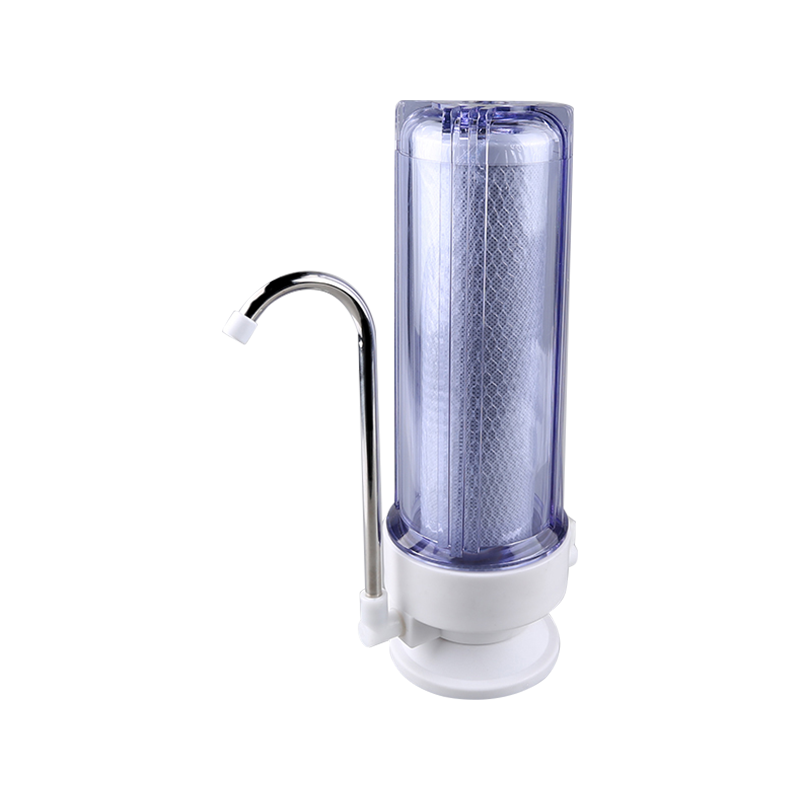
Los filtros de encimera ocupan el punto medio entre los sistemas de jarra y debajo del fregadero. Se colocan en el mostrador, se conectan al grifo mediante una manguera desviadora y filtran el agua según sea necesario sin necesidad de cambios permanentes en la plomería. Para los inquilinos que desean un mejor rendimiento que un filtro de jarra pero no pueden instalar una unidad debajo del fregadero, los sistemas de encimera ofrecen un compromiso práctico.
Sistemas de encimera por gravedad versus sistemas de encimera presurizados
Los sistemas de encimera alimentados por gravedad (como los filtros estilo Berkey) no utilizan presión de agua ni conexión al grifo. Dependen de la gravedad para extraer agua a través de elementos filtrantes de cerámica o carbón con el tiempo. Estos sistemas pueden lograr un rendimiento de filtración excepcionalmente alto, incluida la reducción de bacterias y protozoos, porque el caudal muy lento a través de un medio cerámico denso permite un tiempo de contacto prolongado. Los sistemas de encimera presurizados se conectan al grifo y filtran según demanda a la presión normal del agua del hogar, con caudales similares a las unidades montadas en el grifo.
Guía para compradores de tratamiento de agua: cómo adaptar el filtro adecuado a su situación
Elegir el sistema adecuado entre los disponibles opciones de filtración de agua Todo se reduce a cuatro factores: la calidad del agua, el tamaño de su hogar, su situación de vida (inquilino versus propietario) y su presupuesto. Utilice el marco de decisión a continuación para limitar sus opciones.
Paso 1: conozca su agua
Cada condado de los Estados Unidos debe publicar un Informe de Confianza del Consumidor (CCR) anual que detalla los resultados de las pruebas de agua municipales. Acceder a este informe es el primer paso más útil para seleccionar un filtro porque le indica exactamente qué hay en el agua a nivel del sistema. Para el agua de pozo, es esencial una prueba de laboratorio certificada independiente, ya que el agua de pozo no está regulada por la Ley de Agua Potable Segura. Conocer su perfil de contaminante específico evita comprar un filtro que no aborde sus preocupaciones reales sobre la calidad del agua.
Paso 2: Haga coincidir la tecnología de filtrado con los contaminantes
Una vez que sepa lo que hay en su agua, hacer coincidir la tecnología con el contaminante es sencillo utilizando la guía a continuación. Esta es la lógica central de cualquier guía para compradores de tratamiento de agua :
- Cloro y sabor/olor: Cualquier filtro de carbón activado (jarra, grifo, encimera, carbón debajo del fregadero o carbón para toda la casa) maneja esto de manera efectiva.
- Plomo: Filtros o sistemas RO con certificación NSF/ANSI 53. No todos los filtros de carbón están certificados para la reducción de plomo, por lo que la verificación de la certificación es esencial.
- Quistes (Giardia, Cryptosporidium): Filtros clasificados en 1 micrón absoluto o más fino, o certificación de quiste NSF/ANSI 53.
- Nitratos: La ósmosis inversa solo se encuentra entre las opciones residenciales comunes.
- Fluoruro: Ósmosis inversa o medios de alúmina activada. El carbón estándar no reduce el fluoruro.
- Dureza (calcio y magnesio): Ablandador de agua (intercambio iónico) o acondicionador sin sal para toda la casa.
- Bacterias y virus: Tratamiento UV, RO o filtración cerámica certificada. El carbono estándar no aborda de manera confiable la contaminación biológica.
- Hierro y manganeso: Medios filtrantes oxidantes (arena verde, carbón catalítico) o etapas filtrantes específicas de hierro para toda la casa.
Paso 3: evalúe su situación de vida
Los inquilinos que no tienen permiso para modificar las plomería se limitan a sistemas de jarra, grifos o encimeras. Los propietarios tienen acceso a la gama completa, incluidas opciones debajo del fregadero y para toda la casa. Si se encuentra en una casa en la que planea quedarse por más de 3 a 5 años, la inversión en un sistema debajo del fregadero o en un sistema para toda la casa casi siempre se amortiza en comparación con el costo continuo del cartucho de una jarra o un filtro de grifo.
Paso 4: comprender las certificaciones de filtros
NSF International e IAPMO (Asociación Internacional de Funcionarios de Plomería y Mecánica) son los dos organismos de prueba externos más reconocidos para filtros de agua residenciales. Al evaluar Los mejores filtros de agua para el hogar. , busque específicamente:
- NSF/ANSI 42: Efectos estéticos que incluyen sabor, olor y partículas a cloro.
- NSF/ANSI 53: Efectos sobre la salud que incluyen plomo, quistes, COV y otros contaminantes regulados.
- NSF/ANSI 58: Sistemas de ósmosis inversa específicamente.
- NSF/ANSI 44: Ablandadores de agua.
- NSF/ANSI 55: Sistemas de desinfección UV.
Filtros de agua recomendados por categoría y caso de uso
En lugar de recomendar marcas específicas (que cambian con frecuencia a medida que los productos se actualizan o descontinuan), esta sección describe los criterios de especificación que definen consistentemente filtros de agua recomendados en cada categoría según datos de pruebas independientes y estándares de certificación.
| Caso de uso | Tipo recomendado | Especificaciones clave a buscar | Certificaciones necesarias |
| Inquilino, agua de la ciudad, solo preocupación por el sabor. | Montado en grifo o jarra | Medios de bloque de carbón, duración del cartucho de 200 galones | NSF 42, NSF 53 |
| Familia de cuatro personas, agua municipal, empresa de plomo | Carbono debajo del fregadero o RO | Certificación de plomo NSF 53, 0,5 micras o más fina | NSF 42, NSF 53 |
| Alta preocupación (nitratos, fluoruro, arsénico) | Ósmosis inversa debajo del fregadero con remineralización | Membrana RO, producción de 50 GPD, etapa de alcalinización. | NSF 58 |
| Agua de pozo, riesgo de bacterias | Multietapa para toda la casa con UV | Prefiltro de sedimentos, etapa de carbón, UV 40 mJ/cm2 | NSF 55 para etapa UV |
| Agua dura en toda la casa | Suavizante o acondicionador para toda la casa | Capacidad de grano adaptada al tamaño del hogar, con o sin sal | NSF 44 |
| Sin instalación posible, máxima portabilidad | Encimera de gravedad (cerámica) | Filtro cerámico de 0,2 micrones o más fino, reducción de bacterias verificada. | NSF 53 o equivalente |
Filtros de agua alcalinizantes: lo que realmente dice la ciencia
el filtro de agua alcalinizante La categoría ha aumentado significativamente en el interés de los consumidores durante la última década, impulsada por las afirmaciones sobre el agua alcalina y sus posibles beneficios para la salud. Vale la pena separar lo que está bien establecido de lo que aún no se ha demostrado.
Qué hace realmente un filtro alcalinizante
Una etapa de filtro alcalinizante agrega calcio, magnesio y, a menudo, potasio nuevamente al agua, elevando el pH de una salida de RO típicamente ligeramente ácida (alrededor de 6,0 a 6,8) a un nivel neutro o ligeramente alcalino de 7,0 a 8,5. Hay dos tecnologías principales: cartuchos de remineralización (que simplemente disuelven pasivamente compuestos minerales en el agua) y ionizadores electrolíticos (que utilizan electrólisis para separar el agua en corrientes alcalinas y ácidas).
Beneficios prácticos versus beneficios reclamados
el práctico y bien apoyado El beneficio de la remineralización es un mejor sabor. El agua RO sin remineralización puede tener un sabor soso porque carece del carácter mineral disuelto que le da al agua del grifo y de manantial su sabor familiar. La adición de calcio y magnesio restablece este sabor. Las afirmaciones más amplias sobre los beneficios para la salud del agua alcalina (como las afirmaciones sobre la prevención del cáncer o la desintoxicación) no están respaldadas por evidencia clínica sólida y deben evaluarse críticamente. Sin embargo, no hay ningún daño en beber agua bien mineralizada con un pH neutro a ligeramente alcalino, y la mejora del sabor por sí sola hace que la remineralización sea una adición valiosa a cualquier sistema de ósmosis inversa.
Mantenimiento del filtro: el factor más importante en el rendimiento a largo plazo
el most consistent finding across independent testing of residential water filters is that a well-maintained budget filter outperforms a neglected premium filter. Filter maintenance is the most controllable variable in long-term filtration performance, yet it is also the most frequently overlooked aspect of buena filtración de agua en el uso doméstico del mundo real.
Por qué son importantes los cronogramas de reemplazo de filtros
Los filtros de carbón activado tienen una capacidad de adsorción finita. Una vez que los poros de carbono están saturados con los contaminantes capturados, el filtro ya no los elimina del agua que los atraviesa. En algunos casos, los contaminantes ya capturados pueden liberarse parcialmente al agua filtrada a medida que el filtro se sobrecarga. Un filtro que ha excedido su capacidad nominal puede brindar una falsa seguridad sin filtrar realmente el agua. La capacidad del filtro se clasifica en galones y es una guía más confiable que el tiempo por sí solo, ya que las tasas de uso varían significativamente entre hogares.
Reemplazo de membrana RO
Las membranas de RO son los consumibles más caros en un sistema de RO debajo del fregadero, pero también los de mayor duración y, por lo general, requieren reemplazo cada 2 a 5 años en condiciones normales de agua municipal. Los cartuchos de prefiltro en los sistemas de ósmosis inversa (prefiltros de sedimento y carbón) necesitan ser reemplazados con mayor frecuencia, generalmente cada 6 a 12 meses, y la protección de la membrana depende de que estos prefiltros se reemplacen según lo programado.
Programa de mantenimiento del sistema para toda la casa
Para cualquier propietario que administre Cómo elegir un sistema de filtración de agua para toda la casa. A largo plazo, el programa de mantenimiento es tan importante como la compra inicial. Los prefiltros de sedimentos en sistemas para toda la casa generalmente requieren reemplazo cada 3 a 6 meses. Los sistemas de tanques de carbón grandes a menudo tienen medios clasificados para una duración de 5 a 10 años antes del cambio de medios. Los ablandadores de agua requieren un reabastecimiento regular de sal (mensualmente para la mayoría de los hogares) y una recarga o reemplazo del lecho de resina aproximadamente cada 10 a 15 años.
Recomendaciones finales: combinar el filtro adecuado con sus necesidades
el range of opciones de filtración de agua disponible hoy en día significa que existe un sistema adecuado para prácticamente cada hogar, presupuesto y situación de calidad del agua. La clave es comenzar con los datos reales sobre la calidad del agua y avanzar a partir de ahí, en lugar de comenzar con un producto y esperar que aborde sus inquietudes específicas.
Comience con una prueba de agua. Haga coincidir la tecnología con los contaminantes. Verificar las certificaciones NSF/ANSI. Considere el costo total de propiedad, no solo el precio de compra. Reemplace los filtros a tiempo.
- Lo mejor para inquilinos y hogares pequeños: Filtro montado en grifo o filtro de jarra con certificación NSF 42 y 53 con medio de bloque de carbón y cartucho de al menos 150 galones de duración.
- Lo mejor en general para propietarios de viviendas: Bloque de carbón de múltiples etapas debajo del fregadero para agua urbana, o RO debajo del fregadero con etapa de remineralización alcalinizante para perfiles de contaminantes de alta preocupación.
- Lo mejor para la protección de todo el hogar: Sistema de varias etapas para toda la casa configurado en base a una prueba de agua certificada, dimensionado para la demanda máxima de GPM de la casa.
- Lo mejor para agua de pozo: Sistema de varias etapas para toda la casa que incluye filtración de sedimentos, eliminación específica de contaminantes según los resultados de las pruebas y desinfección UV como etapa final.
- La mejor opción sin instalación: Filtro cerámico de encimera por gravedad con reducción verificada de bacterias y quistes, mantenido según el programa de limpieza y reemplazo recomendado por el fabricante.
La selección de un filtro de agua de buena calidad consiste, en última instancia, en combinar la tecnología adecuada con el problema adecuado. Con la información sobre la estructura y el filtro de agua de esta guía, tiene todo lo necesario para tomar una decisión segura y bien informada para su hogar.
 >
> >
> >
> >
> >
> >
> >
> >
> >
> >
> >
> >
>